|
Scientific Classification: Columba livia
The rock dove, more commonly referred to as a pigeon, is one of 11 species of the family Columbidae that breed in India.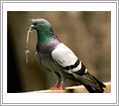 Perhaps the most ever-present pest bird, pigeons have adapted to a variety of environments, from cities to agricultural settings and from buildings to cliffs. They have become the most serious bird pest associated with buildings. Perhaps the most ever-present pest bird, pigeons have adapted to a variety of environments, from cities to agricultural settings and from buildings to cliffs. They have become the most serious bird pest associated with buildings.
Identification:
Varies in color from white to black. Most are characterized by a dark gray head with iridescent sheen, a light gray back and wings with two dark bands. The Pigeon has Stocky body with short legs, a short neck and a small head. During flight, the tip of the tail is usually square and black.
Popular nesting /roosting sites
Biology
Starlings usually select nesting sites that are in the shadows of brighter light. In urban areas, they tend to roost in building cavities at heights 20 to 70 feet (6 to 21 m) above the average street light. In suburban and rural settings, they often nest in tree holes, birdhouses with holes larger than 1.5 inches (4 cm) in diameter and other protected areas 2 to 60 feet (1 to 18 m) above the ground.
Nests are constructed of twigs, grass and debris, then lined with feathers and other soft materials.
Habits
During spring and early summer, the principal diet of nesting birds is insects and occasionally soft fruit. During late summer, fall and winter, their diet preference shifts to grains, seeds and fruits.
When they return to the roosting area at dusk, they first perch on telephone wires, bridges, buildings, trees and other similar items. After sunset, they fly around the roosting site, perhaps several times, before settling in for the evening.
Damage
Indian starlings have been known to nest in dryer vents as well as vents in kitchens, bathrooms and over ovens. Starlings contaminate animal feed and foul buildings and sidewalks in the vicinity of their roosts. Most people are bothered by this accumulation of droppings and the irritating noises starlings create at their roosting sites.
Scientific Classification:
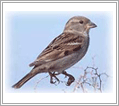
Passer domesticus It is distributed throughout india and has become well established in rural and urban settings.
Identification:
Approximately 5 inches long.
-
Color varies with the gender. Males have a black patch under the beak, on the cheeks and on the rump. In the winter, the gray feather tips hide these black areas. The top of the male sparrow’s head is gray-white. Females and young sparrows are dull brown, with a dirty white breast and brow.
Biology
Sparrows prefer to nest in protected man-made and natural areas. Both male and female sparrows construct a large and flimsy nest from straw, grass, feathers, strips of paper, string and other debris.
The following are popular sparrow nesting sites:
Habits
In rural settings, sparrows cause considerable damage to crops such as wheat and sorghum, as individuals consume as much as 0.2 ounces (6 grams) per day. They congregate in urban areas in the winter and disperse to rural areas in the spring. Flocks of juvenile birds and non-breeding adults sometimes travel four to five miles from nest sites to feeding areas.
Damage
A growing problem is house sparrow’s frequent nesting in kitchen, bathroom, oven and dryer vents. They foul structures with their droppings, particularly those areas used for roosting and loafing sites. Sparrows also create problems by entering food plants, warehouses, department stores and malls where they often contaminate food products or other merchandise. Their droppings can contain a variety of disease-causing bacteria, fungi, nematodes, etc. Sparrows are also considered one of the major reservoirs of St. Louis Encephalitis. Further, numerous blood-feeding parasitic mites associated with sparrows also bite humans.
Scientific Classification: Larus arentatus, Larus delawarensis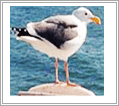
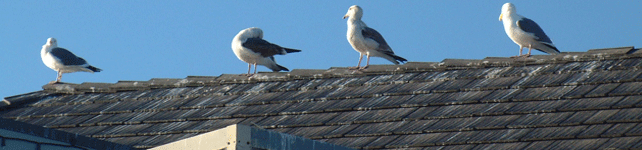
The herring gull, Larus arentatus, and ring-billed gull, Larus delawarensis, (Family: Laridae) are two of the more than 50 species of gulls throughout the country.
Identification:
Gulls are distinguished from other birds based on their large size, long pointed wings, square tails, hooked bills and webbed feet. Herring gull is 23 to 26 inches (58 to 66 centimeters) long. It has a light gray back and wings, which have black tips with white spots. It has a white head and breast, a red spot near the tip of the lower portion of its bill and yellow eyes. Ring-billed gull is 18 to 20 inches (46 to 51 centimeters) long. It has a slightly darker gray back and wings, which have black tips with white spots. It has a white head and breast, a black ring near the tip of its bill and yellow eyes. Laughing gull is 15 to 17 inches (38 to 43 centimeters) long and is easily recognized by its black head. The greater black-backed gull is black on its back and the top of its wings; however, the wing tips are white, as are its head, breast and tail.
Biology
Both species tend to nest in colonies on the ground. The nest is constructed of seaweed, grass, sticks and feathers. Herring gulls occasionally nest on ledges or cliffs, whereas ring-billed gulls occasionally nest in low trees.
Habits
Gulls feed on a wide variety of materials, including fish, clams, mussels, garbage, dead animals, insects, earthworms, rodents and fledgling gulls. The ring-billed gull is the species most often found around fast food restaurants, whereas the herring gull prefers landfill areas. They often loaf in large open areas with a good field of view.They are very gregarious birds, often roosting by the thousands during the breeding season and winter. It is not uncommon to find several species roosting together. Feeding sites can be located as far as 40 miles (64 kilometers) from the roosting area.
Damage
Gulls in the urban environment are often a major nuisance. They foul public areas and residential and commercial buildings with their extremely smelly droppings. They can be very noisy and aggressive when begging for food. Gulls are responsible for more than 50 percent of documented aircraft bird strikes. Furthermore, they are a particular nuisance around harbors, landfills and agricultural areas. Ring-billed gulls have adapted their nesting habitat to rooftops of buildings in some locations. The feathers and litter the gulls bring into the nest site cause roof drains to clog and water overflows into the buildings below. They also peck holes in flat roofs covered with rubber type coatings. The resulting leaks cause damage to the buildings’ ceilings and contents. |
|
Scientific Classification: Sturnus vulgaris
Starlings occur in a wide range of habitats, from farms to urbanized areas.
Identification:
Color varies with the season: In the summer, they are purplish-black with an iridescent sheen; in the winter, the tips of the feathers are marked with white and gold, giving them a speckled appearance. Long pointy bill, bright yellow in the spring and summer, turns dark in the winter. Stocky body and their very short tail makes them appear tailless. Starlings produce a number of harsh rasping, squawking and squeaking calls.
The following are popular sparrow nesting sites:
Biology
Starlings usually select nesting sites that are in the shadows of brighter light. In urban areas, they tend to roost in building cavities at heights 20 to 70 feet (6 to 21 m) above the average street light. In suburban and rural settings, they often nest in tree holes, birdhouses with holes larger than 1.5 inches (4 cm) in diameter and other protected areas 2 to 60 feet (1 to 18 m) above the ground
Nests are constructed of twigs, grass and debris, then lined with feathers and other soft materials.
Habits
During spring and early summer, the principal diet of nesting birds is insects and occasionally soft fruit. During late summer, fall and winter, their diet preference shifts to grains, seeds and fruits. When they return to the roosting area at dusk, they first perch on telephone wires, bridges, buildings, trees and other similar items. After sunset, they fly around the roosting site, perhaps several times, before settling in for the evening.
Damage
Indian starlings have been known to nest in dryer vents as well as vents in kitchens, bathrooms and over ovens. Starlings contaminate animal feed and foul buildings and sidewalks in the vicinity of their roosts. Most people are bothered by this accumulation of droppings and the irritating noises starlings create at their roosting sites. |